Musashi’s duel with Arima Kihei
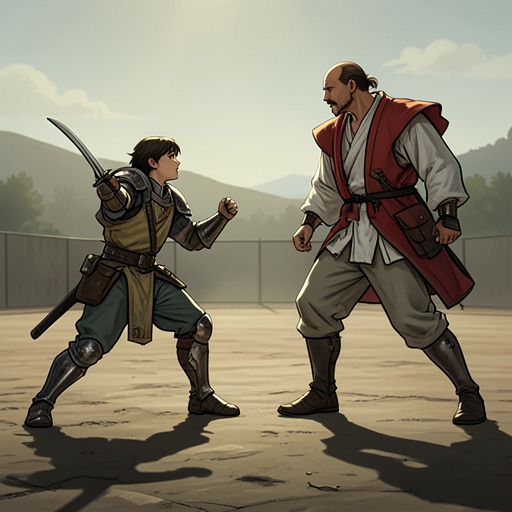
The Book of Five RingsMusashi’s duel with Arima Kihei was Miyamoto Musashi’s first recorded encounter and an early victory that later became a point of departure for his account of the Way of Strategy. Musashi says he struck down Arima at thirteen; in retrospect, however, he refuses to treat that result as proof that he had already mastered strategy. The duel’s importance lies both in the victory and in the question it eventually raised about what victory means and how it is achieved.
The First Duel
In his account of his life, Musashi places the encounter at the beginning of a sequence of contests. At thirteen, he struck down Arima Kihei, whom he describes as a strategist of the Shinto school. At sixteen, he struck down another able strategist, Tadashima Akiyama. By twenty-one, he had gone to the capital and met strategists in many contests, reporting that he had not failed to win. The reference to Arima is therefore brief but specific: it marks the first point in a career Musashi presents as a sustained testing of himself against practitioners of other traditions.
Musashi gives no details of the duel’s location, weapons, course, or immediate aftermath. The account supplies neither dialogue nor a description of how the encounter was fought. What it does establish is the outcome as Musashi remembers it: he struck Arima down. The restraint of the report matters. Rather than reconstructing a dramatic scene, Musashi uses the contest as a dated measure of experience, setting its outcome beside later encounters and the longer process of learning that followed.
Victory Reconsidered
After the early duels, Musashi says he travelled from province to province, fighting strategists of various schools and winning as many as sixty encounters between the ages of thirteen and twenty-eight or twenty-nine. When he reached thirty, he looked back on those victories and reconsidered their cause. He could not conclude that they had resulted from mastery of strategy; natural ability, the order of heaven, or the inferiority of the other schools might instead explain them. Arima’s defeat thus belongs to a record of success that Musashi himself treats as inconclusive evidence of understanding.
That retrospective doubt changes the meaning of the first duel. The account does not present victory as self-validating expertise: a fighter may prevail without yet grasping the principle behind success. Musashi says that after this reassessment he studied morning and evening, searching for the underlying principle, and came to realize the Way of Strategy at fifty. His remembered defeat of Arima begins a chronology whose decisive turn is not another victory but the recognition that victories alone could not explain the Way.
From Duel to Strategic Principle
In the book’s account of strategy, individual combat provides a starting point for a broader discipline. Musashi describes strategy as the warrior’s craft, practiced by commanders and to be understood by their troops. He presents the warrior’s Way as requiring resolute acceptance of death, while distinguishing that strategic discipline from other kinds of willingness to die: its purpose is overcoming opponents, whether by crossing swords with individuals or engaging large numbers in battle. The youthful duel with Arima belongs to the individual scale of this account, but the principles Musashi later develops are not confined to a single contest.
The book explicitly carries strategy from the single opponent to large-scale conflict. Musashi argues that training with a sword can teach a strategist to understand an enemy’s strategy, strength, and resources, even though a thousand or ten thousand men cannot be assembled for ordinary practice. He similarly describes reading an enemy’s disposition—whether it is flourishing or waning—and using the best position to determine how one’s forces should move. In a duel, he says, the fighter must recognize the opponent’s school, quality, strengths, weaknesses, rhythm, and appropriate moment of attack. These are principles developed across the work, not reported as particular actions in the encounter with Arima.
Place in the Book’s Account
Musashi organizes the Way across five books: Ground, Water, Fire, Wind, and Void. He presents them as different aspects of strategy rather than as a chronicle of his duels. The recollection of Arima appears within the introductory account of Musashi’s experience, before the systematic instruction; its function is biographical and argumentative. It establishes the beginning of practice, while the five-book structure sets out what Musashi eventually believes that practice must teach.
The Wind Book, in particular, places Musashi’s school in relation to other traditions. He says that understanding other schools is necessary to grasp the essence of his own, yet declines to name particular schools or settle their doctrines, since branches and interpretations differ. This comparative outlook gives context to his early contests with strategists of other schools, including Arima, without supplying details about Arima’s particular methods beyond Musashi’s identification of his tradition.
The duel therefore survives in the book not as a fully narrated fight but as the first entry in a self-questioning history of practice. Musashi’s later account joins personal combat to training, judgment, and command, while his reassessment prevents early success from standing as the final measure of skill. The encounter’s recorded outcome is decisive; its larger significance emerges from what Musashi says came afterward: a search for the principle that victories, by themselves, had not yet disclosed.